

Another Picture from the Past…January, 2017

Picture from the Past…January, 2017

Daily Readings for Saturday, April 20th
24 Hours a Day
Meditation for the Day
There are two paths, one up and one down. We have been given free will to choose either path. We are captains of our souls to this extent only. We can choose the good or the bad. Once we have chosen the wrong path, we go down and down, eventually to death. But if we choose the right path, we go up and up, until we come to the resurrection day. On the wrong path, we have no power for good because we do not choose to ask for it. But on the right path, we are on the side of good and we have all the power of God’s spirit behind us.
Prayer for the Day
I pray that I may be in the stream of goodness. I pray that I may be on the right side, on the side of all good in the universe.
Language of Letting Go
Deadlines
I don’t know whether I want in or out of this relationship. I’ve been struggling with it for months now. It’s not appropriate to let it hang indefinitely. I will give myself two months to make a decision.
—Anonymous
Sometimes, it helps to set a deadline.
This can be true when we face unsolved problems, are struggling with a tough decision, have been sitting on the fence for a while, or have been floundering in confusion about a particular issue for a time.
That does not mean a deadline is written in stone. It means that we are establishing a time frame to help ourselves not feel so helpless and to help bring a solution into focus. Setting deadlines can free our energy to set the problem or issue aside, to let go, and allow the Universe, our Higher Power, and ourselves to begin to move toward a solution.
We don’t always need to tell people we’ve got a deadline. Sometimes, it’s better to be silent, or else they may feel we are trying to control them and may rebel against our deadline. Sometimes, it is appropriate to share our deadlines with others.
Deadlines are primarily a tool to help ourselves. They need to be reasonable and appropriate to each individual situation. Used properly, deadlines can be a beneficial tool to help us get through difficult problems and situations without feeling trapped and helpless. They can help us let go of worrying and obsessing, so we can focus our energies in more constructive directions. Setting a deadline can help move us out of that uncomfortable spot of feeling victimized by a person or a problem we can’t solve.
Deadlines can help us detach and move forward.
Today, I will consider whether a deadline might be helpful in some areas in my life. I claim Divine Wisdom and Guidance in setting appropriate deadlines for any problems or relationship issues that may be lingering.
Appreciation and Gratitude…

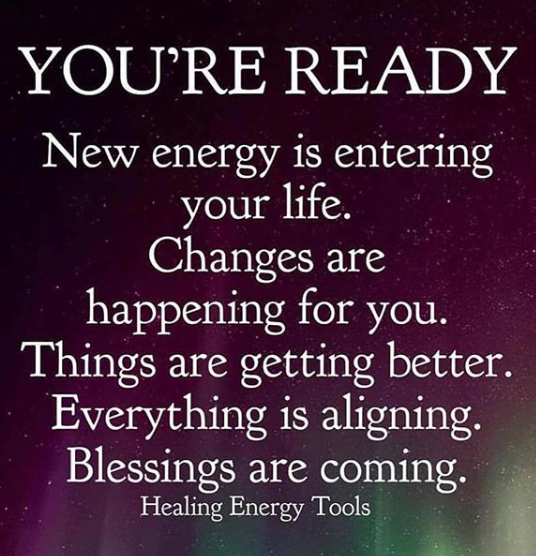
You’re Ready…
Daily Readings for Friday, April 19th…
24 Hours a Day
Meditation for the Day
It is a glorious way – the upward way. There are wonderful discoveries in the realm of the spirit. There are tender intimacies in the quiet times of communion with God. There is an amazing, almost incomprehensible understanding of the other person. On the upward way, you can have all the strength you need from that Higher Power. You cannot make too many demands on Him for strength. He gives you all the power you need, as long as you are moving along the upward way.
Prayer for the Day
I pray that I may see the beautiful horizons ahead on the upward way. I pray that I may keep going forward to the more abundant life.
Language of Letting Go
Accepting Change
The winds of change blow through our life, sometimes gently, sometimes like a tropical storm. Yes, we have resting places – time to adjust to another level of living, time to get our balance, time to enjoy the rewards. We have time to catch our breath.
But change is inevitable and desirable.
Sometimes, when the winds of change begin to rustle, we’re not certain the change is for the better. We may call it stress or a temporary condition, certain we’ll be restored to normal. Sometimes, we resist. We tuck our head down and buck the wind, hoping that things will quickly calm down, get back to the way things were. Is it possible we’re being prepared for a new normal?
Change will sweep through our life, as needed, to take us where we’re going. We can trust that our Higher Power has a plan in mind, even when we don’t know where the changes are leading.
We can trust that the change-taking place is good. The wind will take us where we need to go.
Today, help me, God, to let go of my resistance to change. Help me be open to the process. Help me believe that the place I’ll be dropped off will be better than the place where I was picked up. Help me surrender, trust, and accept, even if I don’t understand.
Fire-Breathing Dragon

My daughter and I at work together
Days of working together are quickly coming to a close,,, so the pictures mean even more,,, even the silly ones


Shared Reading – “Jesus’ Death” – by Richard Rohr
Richard Rohr’s Daily Meditation
From the Center for Action and Contemplation
Week Sixteen
Jesus’ Death
Layered Meanings
Thursday, April 18, 2019
Holy Thursday
Two theologians I deeply respect, Marcus Borg (1942-2015) and John Dominic Crossan (b. 1934), offer important historical and symbolic context for the crucifixion. The theory of “penal substitutionary atonement” only became dominant in recent centuries. [1] Over the next two days, consider their advanced perspective on Jesus’ death on the cross:
This common Christian understanding goes far beyond what the New Testament says. Of course, sacrificial imagery is used there, but the language of sacrifice is only one of several different ways that the authors of the New Testament articulate the meaning of Jesus’s execution. They also see it as the domination system’s “no” to Jesus (and God), as the defeat of the powers that rule this world by disclosing their moral bankruptcy, as revelation of the path of transformation [dying and rising], and as disclosure of the depth of God’s love for us. . . .
Though Mark provides the earliest story of Good Friday . . . Mark’s narrative combines retrospective interpretation with history remembered. . . .
Mark tells us that Jesus was crucified between two “bandits.” The Greek word translated “bandits” is commonly used for guerilla fighters against Rome, who were either “terrorists” or “freedom fighters,” depending upon one’s point of view. Their presence in the story reminds us that crucifixion was used specifically for people who systematically refused to accept Roman imperial authority. Ordinary criminals were not crucified. Jesus is executed as a rebel against Rome between two other rebels against Rome. . . .
[When Jesus died,] “the curtain of the temple was torn in two, from top to bottom” (Mark 15:38). As with the darkness from noon to 3 PM, this event is best understood symbolically and not as history remembered. . . .
To say. . . that the curtain was torn in two has a twofold meaning. On the one hand, it is a judgment upon the temple and the temple authorities . . . who colluded with imperial Rome to condemn Jesus to death. On the other hand, . . . [it] is to affirm that the execution of Jesus means that access to God is now open. This affirmation underlines Mark’s presentation of Jesus earlier in the gospel: Jesus mediated access to God apart from the temple and the domination system that it had come to represent in the first century.
Then Mark narrates a second event contemporaneous with Jesus’s death. The imperial centurion in command of the soldiers who had crucified Jesus exclaims, “Truly this man was God’s Son” (15:30). . . .
That this exclamation comes from a centurion is very significant. According to Roman imperial theology, the emperor was “Son of God”—the revelation of God’s power and will for the earth. According to the same theology, the emperor was Lord, Savior, and the one who had brought peace on earth. But now a representative of Rome affirms that this man, Jesus, executed by the empire, is the Son of God. Thus the emperor is not.
Gateway to Presence:
If you want to go deeper with today’s meditation, take note of what word or phrase stands out to you. Come back to that word or phrase throughout the day, being present to its impact and invitation.
[1] For more on atonement, see Richard Rohr, “Jesus and the Cross,” February 3-9, 2019, https://cac.org/jesus-and-the-cross-weekly-summary-2019-02-09/.
Marcus Borg and John Dominic Crossan, The Last Week: What the Gospels Really Teach About Jesus’s Final Days in Jerusalem (Society for Promoting Christian Knowledge: 2008), 139, 141, 147, 150-151.
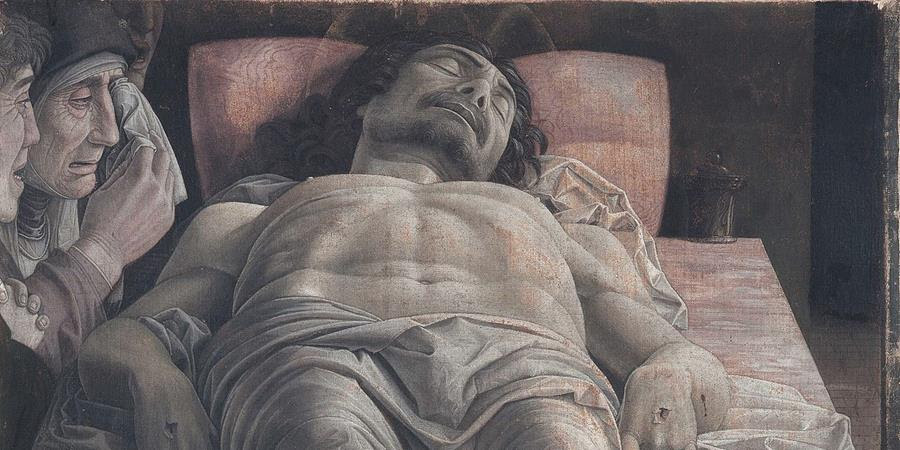
Image credit: Lamentation of Christ (detail), Andrea Mantegna, 1470-1474, Pinacoteca di Brera, Milan, Italy.
 David Lee